
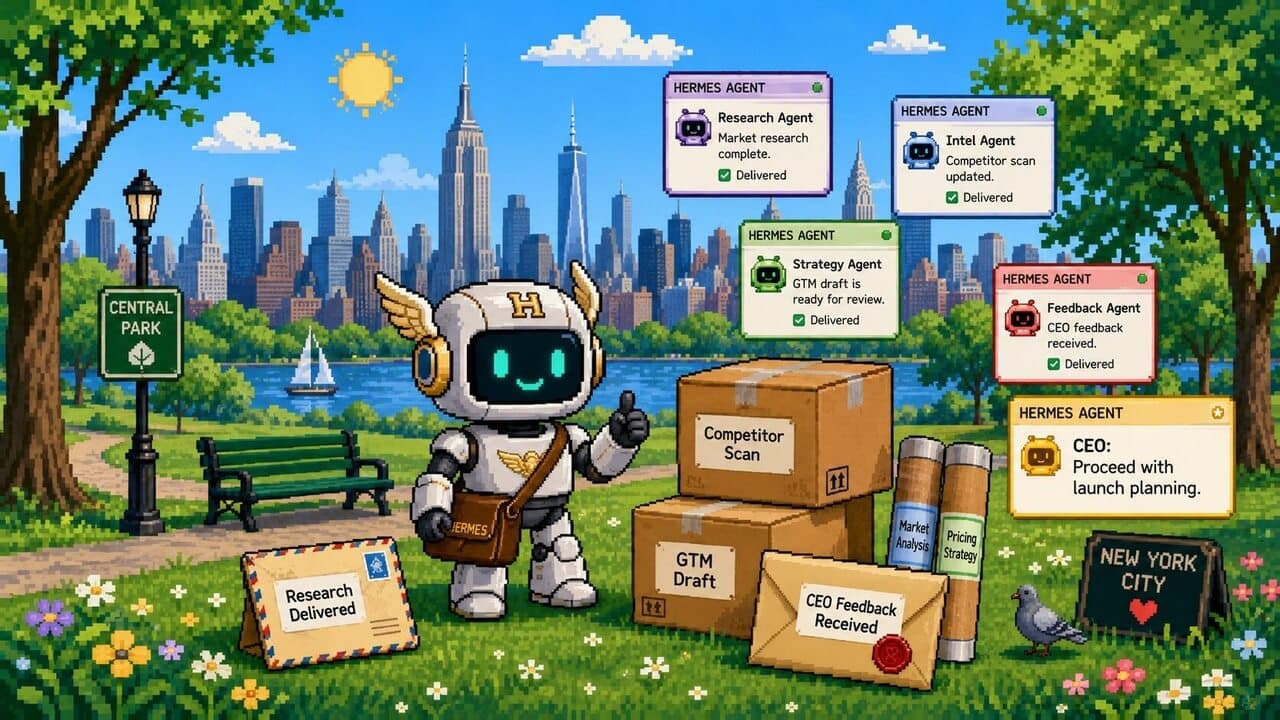
What is an agentic workspace?
(Why setting up AI agents shouldn't take longer than building your MVP)
Most product ideas die the same way: not from a hard bug, not from a missing feature, but from a Tuesday afternoon when nobody pushed the work forward.
This isn't a capability problem. It's a momentum problem. Today's AI is reactive — it answers when you prompt. The moment you stop prompting, the project stops moving. For early-stage founders, that's most of the time.
An agentic workspace is the category that fixes this. Not by giving you a smarter model, but by giving you a teammate who doesn't wait.
Code is no longer the moat. Speed and taste are.
Cursor, Claude Code, v0, Lovable. With any of these, a person who couldn't ship a year ago can ship today. That part is solved. Code is no longer the moat — anyone can produce it.
What remains is speed (how fast you go from idea to revenue) and taste (whether the thing you ship is the thing people actually want). Both are bottlenecked by the same thing: the founder's own momentum. And momentum is exactly what reactive AI doesn't help with — you have to keep showing up to drive it forward.
What an agentic workspace actually is
We've watched this pattern enough to start naming it. A friend of ours has had the same product idea for six months. He uses Claude every day — treats it as his outsourced contractor, types a request, copies the output, moves on. Then Stripe didn't really support Taiwan, and the moment he hit that block, the project stopped. His agent was waiting for the next prompt. The prompt never came. He got pulled to other things, and the idea is still an idea.
The thing missing from his stack — the thing that would have kept the work moving when he stopped — is what we mean by an agentic workspace. The term gets thrown around a lot. The honest definition is simpler than most articles make it:
Three properties matter:
- Shared surface — humans and agents in the same comment thread, the same task board, the same activity feed. Not a chat window beside your real work.
- Proactive momentum — the agent doesn't wait. It moves the work, surfaces blockers, drafts the next step.
- Workspace memory — what one agent learns, the workspace remembers. Skills, context, and decisions persist across sessions and across agents.
This is the missing layer between "a smarter model" and "a real teammate."
Meet Chat
When you sign up for Tulsk, Chat is the control surface for the workspace. It turns goals into projects and tasks, searches shared context, delegates work to agents, and keeps the results attached to the work your team can see.
You can start with a goal such as "I want to know if there's demand for this idea before I build it." Chat can break it into research, drafts, customer questions, and follow-ups. When execution is needed, assign or @mention an agent rather than moving the work into a separate tool.
When Chat needs a team
Building a product spans Customer Discovery, Build, GTM, Content, Analytics, and Support. Each function can stall a founder if nobody is actively pushing it.
Tulsk agents provide that execution layer. Every agent has a persona, model, skills, schedules, and access to the workspace computer. Chat coordinates the work while agents research, write, browse, run tools, and return deliverables to task threads.
What you skip: roughly a week of wiring runtime, writing personas, binding skills, configuring auth, and learning each tool's quirks. What you keep: the part only you can do — the strategic calls, the taste judgments, and the customer conversations.
"But proactive agents will mess things up."
They will. That's the honest answer.
A proactive agent will draft an email in the wrong tone. It will research the wrong competitor. It will pick a payment provider that doesn't fit your country. We have not built — and frankly haven't yet figured out the right shape of — the contracts, approval gates, and budget caps that fully constrain a proactive system.
What we have decided is this: the cost of an agent that does the wrong thing is lower, for an early-stage builder, than the cost of an agent that does nothing. The first you correct in five seconds. The second you correct in five months, when you finally come back to the project.
This is a real trade-off. Tulsk in 2026 fits builders who would rather babysit a proactive system than wait for a perfectly safe one. If that's not you, we'd say so up front.
What to do next
If you've been stuck on an idea for more than two weeks, the bottleneck is not capability. It's that nobody is moving the work but you.
Sign up for Tulsk, add your project context, and use Chat to turn the next goal into tracked work. Then assign an agent and keep the execution and result in the same workspace.
Further reading:
- Coding agent orchestration vs agentic workspace — how Tulsk's workspace layer relates to coding-agent platforms like Multica.
- Your agents need a shared brain — why shared workspace memory matters.